
(Editor’s note: the reader must excuse (or enjoy) a brief foray into the history of astronomy, this partially grew out of work presented at the BSHM Research in Progress in 2025. Excitingly, booking for this year’s conference is now open – hope to see you in Oxford!).
An all-encompassing archive?
For the historian of mathematics and astronomy, the archive of the Royal Observatory Greenwich (ROG) is a rich source – it takes up about a football field worth of shelf space in Cambridge University Library (CUL)! The astronomical work, the astronomers who worked there, the instruments and observing spaces have all been very well studied, but there is plenty there to keep us busy for a while yet.
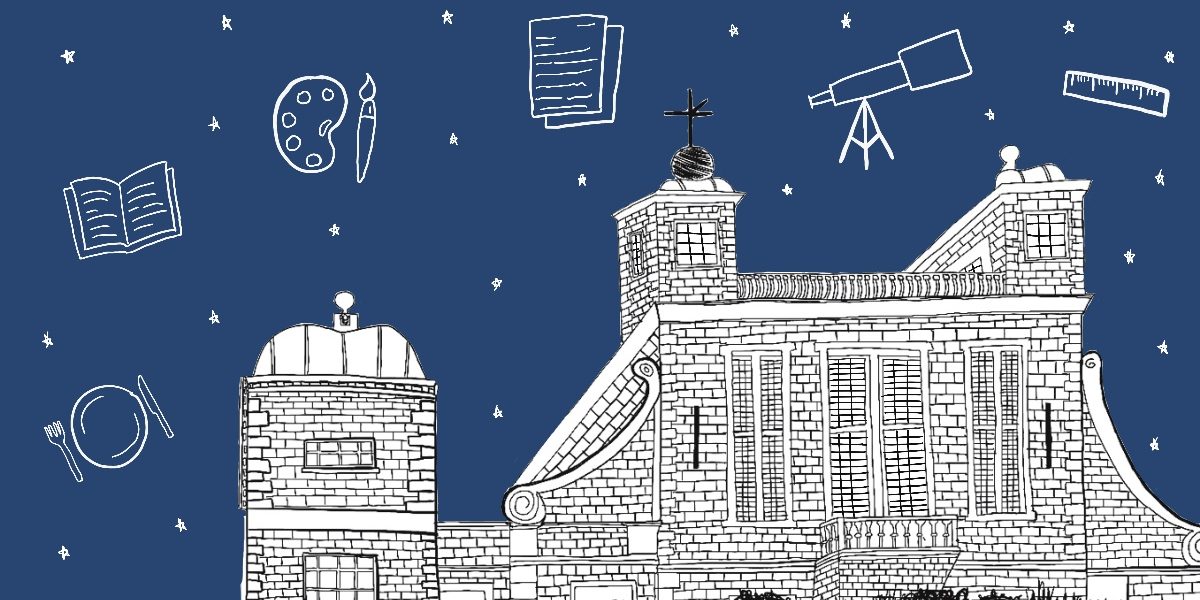
In fact, there is plenty more to say about life at Greenwich from sources that aren’t even officially in the archive of the ROG. Stored in a separate place in the CUL and likely much less frequently consulted, are the personal papers of the Airys – the family who lived at the observatory between 1835 and 1881. George Biddell Airy was the seventh Astronomer Royal (AR): he lived there with his wife, Richarda Airy, and their many children and other relatives. As had been the case since the observatory was established in 1675, the family of the AR lived “on site”. Hints of this domestic history are still visible if you visit today – graffiti left by the children of the ninth AR adorns the bricks by Flamsteed House, the main living space…
The fact that these papers are stored separately from the main observatory papers already alerts us to a divide (somewhat artificial as we will see) constructed between astronomy and family life at the observatory. Amongst these personal papers are 75 letters which span a period of 18 years. They were all written by Richarda Airy to Margaret Herschel, the wife of John Herschel, a very prominent man of science in this period. These brilliantly crafted letters give us a fantastic look at the “behind the scenes” of the Airys’ time at the RGO: what was it like for the Airy family to live at one of Britain’s premier scientific institutions?
The Cambridge prelude
The ROG wasn’t actually the first time that the Airys had lived with a dome over their head, so to say. Richarda and George had lived at Cambridge Observatory between 1828 and 1835, while George was Plumian Professor of Astronomy and director of the observatory there. Richarda seemed to thrive in Cambridge, letters from their friends (including William Buckland, Oxford’s first reader in Geology and William Whewell, Master of Trinity College Cambridge) show how well integrated she and her family were in the university community. Allegedly, Whewell even once ran a race with two of Richarda’s sisters around the roof of King’s College Chapel!
Richarda was reluctant to leave when George got the post as AR but also wanted him to have a better time at work – he was tasked with doing a lot of the menial calculations in Cambridge that, while absolutely essential to the functioning of an observatory, she didn’t see as the best use of his time.
Moving to London
Unsurprisingly, things did not improve in terms of work-life balance when the Airys eventually all moved to the ROG in late 1835. Their arrival had been delayed because the living quarters needed to be expanded for their growing family. At that time this included three children – Richarda would give birth to 9 children; pregnancy and childcare were therefore a fairly consistent and important part of her life in their early years at the RGO.
George had a regular working routine, work began at 9am and first paused at 2.30pm. This block was followed by a walk and a family dinner at the slightly abnormal time (even for the period) of 3.30pm. Rest, tea and more work followed, with the work day ending around 10pm. Long vacations and afternoon walks were used as a coping mechanism by various members of the family. George didn’t often observe but he would still have many tasks to do in the evening. He completed these surrounded by his family in the living quarters; the change of scene and company was seen to take the edge off the work.
A select set of visitors...
The Airys were rarely alone at the ROG. For a start, the family were supported by three domestic servants and a gardener. As well as the domestic, observatory and park staff, with whom the family would interact, there would be a rotating set of characters staying in the living quarters. Unlike today, visitors were largely not allowed on site. However, this rule did not extend to the various friends and family who were able to come and stay with the Airys. Family members helped to care for the children, who were also shared between different scientific households during the holidays. The Airys regularly used to send their children to stay with the Herschels, for example. Greenwich was quite far out of central London, but hosting was still an important function of the ROG – it was crucial for developing relationships and agreements between influential men (and occasionally women) of science. With her musical and conversational talents, many reports of Richarda tend to emphasise her skill in socialising and hosting – although George also had a bit of a reputation for his poetry recitations at these various get togethers!
Raising a family in an observatory
Richarda’s days were otherwise full of things that were holding the observatory and their family together. She was a prolific correspondent for one. When the Airys were living in London, people could get up to six deliveries of post in a single day. It’s almost impossible to imagine now, but people allegedly complained if their post was not delivered within a few hours.
Her days would also have involved teaching their children – when they were old enough, the boys were sent to local grammar schools but the girls were educated mainly at home. There were, however, at least plans for one of the girls to be sent to a day school, on account of Richarda’s fairly regular illnesses. There was no escape from education even during family holidays, George would “make school” with the children and their holiday activities involved mineral, botany and fungi expeditions.
When at home, the children had somewhat free reign of the observatory grounds, sometimes much to the despair of the observatory and park staff. Their eldest surviving son, Wilfrid Airy, was once charged for bathing in one of the reservoirs in Greenwich – he was lucky (or clever?) to do this before the park was open, so he wasn’t charged with indecent bathing or affecting the public. Wilfrid and his younger brother Hubert also received a letter warning them to stop running around the roof of observatory (which had open hatches for the telescopes!). The girls seemed to have taken up less chaotic hobbies – Richarda, her various daughters and sisters painted a series of beautiful pictures of the grounds in and around the observatory. An interesting recent blog series has further explored what these paintings capture and the later lives of the Airy children (part 1, part 2)
A faint record in the archive
Richarda also used her art skills for astronomical purposes – she helped draw a representation of a total solar eclipse when she went with George on their first eclipse expedition in 1842, as well as diagrams for lectures and published reports. The family were all variously involved in astronomical work – including sketching, translating papers, corresponding with observers and scientists and observing themselves. However, again, the letters that reveal these fascinating details are stored separate from the main observatory papers, meaning that the critical involvement of the family in astronomical pursuits is often obscured.
It was very usual for family members, especially wives, to be involved in scientific work in this period – it was relatively unlikely though that this would be referenced or credited fully. The obscuration continues at the level of archiving practices too. Given George’s obsession over managing and creating a vast archival record of the observatory, it would have been a somewhat deliberate choice to leave these papers out of the observatory collection. This is both frustrating and interesting – the historian gets to grapple with various of the Airys’ ideas of what counts as astronomical work, as they try to present particular images of the family, their home and divisions of labour.
With the creation of a very particular archive, it has been easy to dismiss and separate out the Airy family members from the astronomical work taking place – overlooking the way they were also key members of the scientific enterprise run from the top of this hill in London. By exploring the multi-use of a site like the ROG, we can learn about the much broader set of characters involved in the making of astronomical knowledge and the reasons we don’t currently know as much about what “a day in their life” might have involved.
Further reading
Wilfrid Airy (ed.), Autobiography of Sir George Biddell Airy (Cambridge University Press, 1896).
Louise Devoy, Royal Observatory Greenwich: A History in Objects (Royal Museums Greenwich, 2025).
About the Author
Meg Briers is a PhD student at the Max Planck Institute for the History of Science. Her research focuses on women and gender in nineteenth century astronomy expeditions. In order to actually make some use out of her original degree in maths and computer science, she is the current web administrator for the BSHM.