
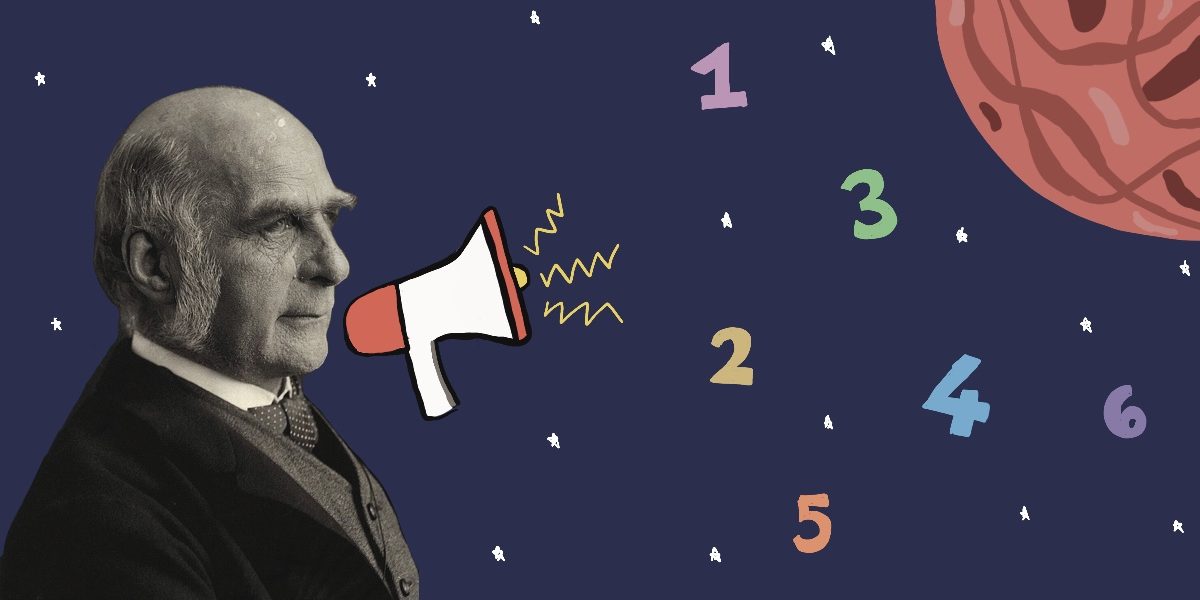
In the late 19th century, as telescopes peered into the mysterious red glow of Mars, a peculiar idea captured the imagination of scientists and the public alike: could we communicate with Martians? Among the many who pondered this question was Francis Galton, a polymath whose legacy in mathematics and science is both profound and controversial. Galton’s musings on interplanetary communication—rooted in his lifelong obsession with counting—offer a fascinating glimpse into the origins of mathematical language as a universal language. This blog post explores Galton’s contributions, his methods, and the enduring influence of his ideas on the search for extraterrestrial intelligence.
Francis Galton: "Whenever you can, count"
Francis Galton (1822–1911) is hardly a household name today, yet his fingerprints are all over the modern scientific landscape. Born into a prosperous Birmingham banking family, Galton’s early academic journey was rocky: he left medical school and dropped out of mathematics at Cambridge, likely due to a nervous breakdown. Yet, his intellectual curiosity was boundless. After travels in the Middle East and Africa, he returned to London and embedded himself in the city’s scientific elite, contributing to the Royal Society, the Royal Geographical Society, and the Meteorological Office, among others. He was knighted, awarded the Copley Medal, and remains a figure of both admiration and debate.
Central to Galton’s approach was his personal motto: “Whenever you can, count.” Whether attending a lecture or strolling down the street, Galton was counting—be it yawns, fidgets, or the hair colour of passers-by. He even invented discreet devices for the purpose, from pricking cards with a needle-tipped glove to a brass counter with push-buttons. Some of his counting was eccentric, bordering on what we might now call arithmomania, but he channelled this compulsion into groundbreaking work. His application of statistical methods to heredity laid the foundations for biostatistics, and he introduced the concept of correlation between variables.
However, Galton’s legacy is shadowed by his advocacy of eugenics—a term he coined. While his early intentions focused on understanding heredity and encouraging the intermarriage of the “intelligent,” this can hardly be disentangled from the crimes committed in the name of eugenics during the 20th century. UCL de-named its Galton Lecture Theatre in 2020.
Counting as Communication: Galton's Martian Signals
Galton’s fascination with counting extended beyond Earthly concerns. In 1892, as Mars drew close to Earth, he wrote to the Times suggesting that sunlight could be reflected from large surfaces to signal the Martians. The idea was simple: use flashes of light to convey information. But how to ensure that any intelligent Martian observers would understand?
Galton’s answer was elegant: begin with numbers. In an unpublished note, he sketched a system where sequences of flashes represented numbers and basic arithmetic:
- Flash (plus) Flash (equal) Flash Flash
- Flash (plus) Flash Flash (equal) Flash Flash Flash
He reasoned that any intelligent beings with “the smallest algebraic knowledge” would deduce the meaning of the symbols for plus and equals. From there, more complex mathematical concepts—geometry, trigonometry, even the law of gravity—could be introduced.
While recuperating in Wildbad, Germany, in 1896, Galton drafted a science fiction story imagining Martians receiving and deciphering such signals. His Martians, ant-like creatures the size of horses, interpreted the initial flashes as numbers, then unravelled arithmetic operations and, eventually, pictorial representations. The story was never finished, but Galton published a more straightforward version, “Signals from Mars,” in the Fortnightly Magazine.
The Legacy of Mathematical Messaging
Galton’s proposal was not the first or last attempt to devise a universal language for interplanetary communication. Earlier schemes had suggested drawing vast geometric figures on the Earth’s surface or using burning mirrors to “write” messages visible from space. But Galton’s insight—that numbers and arithmetic could serve as a common ground—proved remarkably prescient.
As radio technology advanced in the 20th century, the focus shifted from visual to electromagnetic signals. The challenge remained: how to create a message that could be understood without a shared language or context? The answer, time and again, was mathematics. In the 1950s, Lancelot Hogben’s “astraglossa” and Hans Freudenthal’s 1960 “Lingua Cosmica” both began with sequences of pulses representing numbers, building up to more complex scientific concepts.
The tradition continued with the Arecibo message of 1974—a binary-encoded bitmap transmitted to a distant star cluster—and the “Cosmic Call” messages of the late 1990s and early 2000s. These messages, too, started with counting numbers, then introduced arithmetic, physics, and biology. The assumption was always that intelligent life, wherever it might arise, would recognise the sequence 1, 2, 3, 4… as a self-evident truth.
Mathematics as a Universal Language?
Why do so many attempts at interstellar communication begin with counting? The answer lies in the unique status of numbers. Unlike words, which are arbitrary symbols tied to specific cultures, the sequence of counting numbers seems to “signify itself.” It is conceivable that any intelligent species capable of receiving a signal could recognise a pattern of increasing pulses as the concept of number. From this shared foundation, more complex ideas—arithmetic, geometry, science—might be built.
Yet, as critics have pointed out, this assumption is not without risk. There is no guarantee that alien minds would conceptualise mathematics as we do, or that our scientific theories would map onto theirs. Some have proposed sending physical phenomena, such as atomic spectra, as a more direct means of communication. Others suggest transmitting computer programs or formal logic, hoping that the structure itself will be recognisable.
Conclusion: The Enduring Power of Counting
From Galton’s glove-pricked cards to the digital pulses of the Arecibo message, the act of counting has been at the heart of humanity’s efforts to reach across the cosmic void. Galton’s vision—of numbers as the first handshake between worlds—remains a guiding principle in the search for universal language. As we continue to scan the skies and send our mathematical greetings into the unknown, we are reminded of the profound unity that numbers can offer, and of the restless curiosity that drives us to count, to measure, and to communicate—even with the stars.
About the Author
Benjamin Wardhaugh writes about the history of mathematics in culture. His books include Counting (2024), Encounters with Euclid (2020), and Gunpowder and Geometry (2019). He is a former fellow of All Souls College, Oxford and the Warburg Institute, London.