
Staging

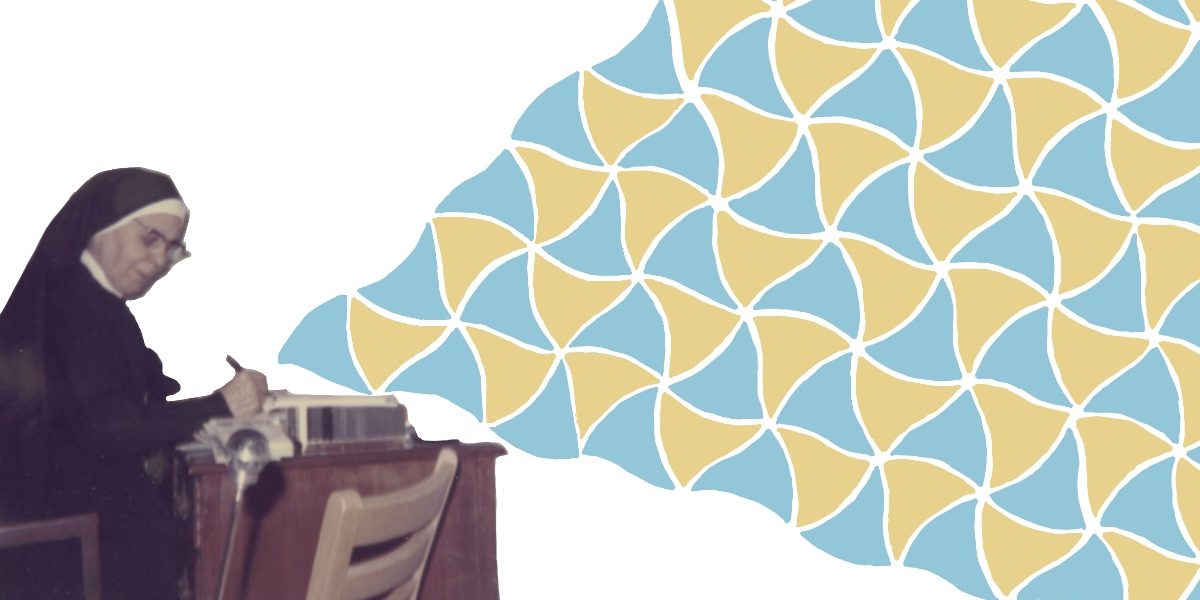
An image of Elli Heesch at a desk with an isometric tiling drawn extending outwards from her pen
Source of original image: SUB Göttingen, Cod. Ms. H. Heesch 258. Additional Illustration: Megan Briers.

Have you ever heard of Elli Heesch (1904-1993), a German logician and philosopher who spent a brief research period at Princeton as a nun? You may have heard of her brother, Heinrich Heesch (1906–1995), a notable German mathematician recognised for developing the “discharging method”, which played a crucial role in the 1977 computer-aided proof of the four-colour theorem. However, the collaboration between Heinrich and Elli Heesch on tiling problems and their industrial applications during World War II remains largely unknown. This blog post aims to shed light on this significant yet overlooked chapter of their lives—a story I have reconstructed in my article “Elli Heesch, Heinrich Heesch and Hilbert’s eighteenth problem: collaborative research between philosophy, mathematics and application”. This article, published in the British Journal for the History of Mathematics in 2024, won the Taylor and Francis Early Career Prize, run by the BSHM. 

The Heesch Siblings: Elli and Heinrich

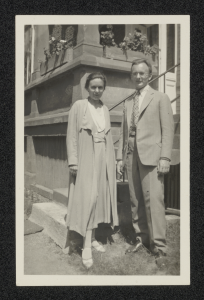
Elli Heesch with her brother Heinrich Heesch in Göttingen in 1931. The siblings stand outside a house at the bottom of a staircase.
Figure 1: Elli Heesch with her brother Heinrich Heesch. Göttingen, Gaußstraße 18; 1931, Pentecost. Reproduced with the permission of SUB Göttingen. Source: Sig. SUB Göttingen, Cod. Ms. H. Heesch 258.

Elli and Heinrich Heesch grew up in a musical family in Schleswig, a small town in the north of Germany. Both pursued their studies in mathematics at the University of Kiel, where they attended lectures by prominent German mathematicians Ernst Steinitz and Otto Toeplitz, who are primarily known for their work in algebra and analysis respectively. In 1929, Heinrich Heesch received his doctorate (Dr. phil.) from the University of Zurich with a dissertation supervised by Gregor Wentzel. His PhD thesis examined the mathematical properties of crystallographic structures, an approach that later influenced his work in tiling and graph theory. Meanwhile, inspired by the philosopher Heinrich Scholz, Elli Heesch developed a strong interest in logic and philosophy. She passed her teaching exam in 1928 and later earned a doctorate in philosophy (Dr. phil.) at the University of Münster under Scholz in 1933. Her dissertation focused on Bernard Bolzano’s theory of science. The rise of National Socialism disrupted the academic plans for both siblings. Heinrich left his university position, while Elli was unable to complete her habilitation, despite undertaking research stays in Tübingen, Innsbruck, Prague, and Warsaw. During this time, she met leading logicians, including members of the Vienna Circle, and published work defending modern formal logic. 

From the mid-1930s, the siblings lived in northern Germany and supported themselves through private tutoring while continuing their mathematical research, particularly on group theory and tiling problems. In 1937, however, Elli accepted a permanent position as a school teacher, which effectively ended her academic career. After the Second World War, Heinrich returned to academic mathematics and focused on the four-colour problem. In contrast, Elli took a different path. In 1946, she entered the Sacred Heart religious order and later became head of the Sophie Barat School in Hamburg. Throughout her life, she remained intellectually active, even studying gerontology at the age of 68 and visiting research institutions in the United States in 1972. She received the Order of Merit of the Federal Republic of Germany in 1993 and passed away later that year at the age of 89. Her brother Heinrich died in 1995.

From Hilbert’s 18th Problem and Anisohedral Tilings to Industrial Design

Hilbert’s 18th problem, proposed in 1900 as part of his famous list of unsolved mathematical problems, poses a question about the existence of anisohedral tilings. Specifically, Hilbert asked whether there exists a polyhedron in three-dimensional Euclidean space that can tile the space but only in a non-isohedral (or, anisohedral) manner.

To understand the question, it helps to start with the idea of tiling. A tiling means covering a space completely with shapes so that there are no gaps and no overlaps. In everyday life, this is similar to how tiles cover a floor. In mathematics, this idea can also be extended to three dimensions, where solid shapes fill all of space. In some tilings, everything is very regular and uniform. This is called an isohedral tiling and in these cases, every tile is in exactly the same situation as every other tile. If you pick up one tile and move or rotate it according to the symmetries of the pattern, you can place it exactly where any other tile is. In other words, all tiles are completely equivalent, as demonstrated in Figure 2.
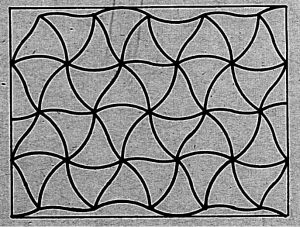
An example of an isometric tiling.
Figure 2: An example of an isometric tiling. Source: Heesch, E; Heesch, H, and Loef, J. System einer Flächenteilung und seine Anwendung zum Werkstoff-und Arbeitssparen. Moosburg: Pichelmayer, 1944.

However, not all tilings are like this. In an anisohedral tiling, all the tiles still have the same shape, but they do not all play the same role. Some tiles are positioned differently in the pattern, and you cannot move one tile onto every other tile using the symmetries of the tiling. Even though the shapes are identical, their positions are not equivalent.

An example of an anisohedral tiling is given below in Figure 3. Despite the blue and red tiles having the same shape, they cannot be mapped onto one another by any symmetry operation (rotation, translation or reflection) of the entire tiling.
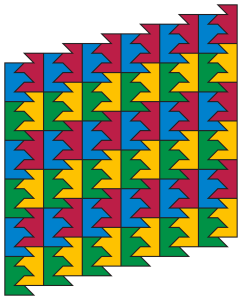
An example of an anisohedral tiling
Figure 3: An example of an anisohedral tiling. Source: David Eppstein, CC0, via Wikimedia Commons

Hilbert’s question asks whether there exists a three-dimensional shape that can fill space completely, but only in this non-uniform way. There are plenty of shapes that tile space in a very regular and symmetric way but Hilbert was again more interested in the shapes that force irregularity, meaning that no matter how you arrange them, some tiles will always have different roles from others. Does this type of unavoidable asymmetry across the tiling exist in three-dimensional space?

In 1928, Karl Reinhardt constructed a polyhedron that tiles three-dimensional Euclidean space but does not admit an isohedral tiling. A few years later, in 1935, Heinrich Heesch resolved the second part of Hilbert’s 18th problem by exhibiting the first example of an anisohedral tile in the plane. This provided an affirmative answer: such tiles do exist. In particular, Heesch showed that a shape can tessellate the plane without serving as a fundamental domain for any symmetry group of the tiling—that is, it cannot produce an isohedral tiling. However, according to the siblings’ report in System einer Flächenteilung (1944), both contributed to this solution through collaboration.

Additionally, in 1932, Elli and Heinrich Heesch had completed a classification of 28 types of asymmetric tiles that produce isohedral tilings. They submitted their work in 1934 but chose not to publish it. Instead, the siblings attempted—unsuccessfully—to patent their mathematical discovery for nearly a decade. In January 1934, Heinrich Heesch delivered lectures in Berlin on tiling problems, which attracted industrial interest, including attention from Villeroy and Boch, leading to practical tile designs. Elli and Heinrich sought industrial applications for mathematical tiling, such as pattern design and efficient material usage in manufacturing. During World War II, their work became valuable for minimising waste when stamping sheet metal. 

In 1938, Heinrich Heesch met Jakob Loef, who became interested in his research and later collaborated with the Heesch siblings. With Loef’s support, their tiling method gained interest from companies like Siemens and Messerschmitt. In 1945, the siblings signed a consulting contract with Siemens, though it collapsed with the end of the war. In 1944, Elli, Heinrich and Jakob Loef published System einer Flächenteilung (trans: System of Area Divisions) together, a confidential report describing a new tiling method aimed at saving materials and labour in industrial production.

Mathematics, Morality, and Memory

The story of Elli and Heinrich Heesch sheds light on a largely overlooked intellectual partnership behind Heinrich’s mathematical work. From the very beginning, Elli accompanied and supported his research, and the siblings shared a lifelong enthusiasm for mathematics. Both were deeply religious, modest, and uninterested in fame, while aspiring to academic careers that proved difficult to sustain. Their collaboration also offers a nuanced perspective on the so-called Matilda Effect—the tendency to overlook women’s contributions in science. Elli did not simply do work for which Heinrich later received credit; rather, their relationship illustrates how intellectual exchange and collaboration can blur clear lines of recognition, especially in precarious academic environments. At the same time, their lives reflect the ethical dilemmas faced by scientists during the Nazi era. Heinrich refused to join the National Socialist German Lecturers League, sacrificing his habilitation. Yet both siblings later worked for the German Army Weapons Agency, a pragmatic decision that ensured financial survival and protected Heinrich from military service.

Further considerations illuminate how their story resonates with contemporary discussions in mathematics and the philosophy of science. Elli’s role challenges the myth of the solitary mathematical genius, foregrounding the significance of collaborative networks and the informal exchange of ideas—topics that are increasingly emphasized in studies of knowledge production. Their experiences underscore the ways in which political, social, and ethical pressures shape scientific inquiry, offering a historical case study for debates about moral responsibility, research integrity, and the sociology of knowledge. Moreover, the Heesch siblings’ blending of abstract mathematics with practical application anticipated current interest in the interplay between pure and applied research, showing that disciplinary boundaries are often porous and that innovation frequently arises from cross-domain collaboration. By examining their intellectual and ethical choices, modern scholars can gain insight into how recognition, gender, and context impact both the development and historiography of science, providing a more nuanced understanding of the complex human dimensions of mathematical work.

Interested in learning more about the Heeschs? Be sure to check out the BSHM award winning article Elli Heesch, Heinrich Heesch and Hilbert’s eighteenth problem: collaborative research between philosophy, mathematics and application”, published in the British Journal for the History of Mathematics.

About the Author

Andrea Reichenberger is a philosopher and historian of science and technology with a focus on women and gender issues at the intersection of physics, mathematics, computing, and AI. She currently leads a DFG-funded project at the Technical University of Munich, examining the role of women in the history of quantum physics.